The fall intake in USA is the main admission cycle at American universities. Classes begin in late August or September, and it's the intake most Indian students choose.
Still wondering when the fall intake in USA and when to apply? Classes for Fall 2027 start in August or September 2027. Top universities like MIT, Stanford and Harvard close their early bachelor's rounds on 1 November 2026. Most master's programs close between December and June, depending on the course.
In this article, you'll find the fall intake in USA deadlines, the full timeline, eligibility and documents. You'll also see a list of universities in USA for fall intake, top scholarships and how to apply step by step.
Fall Intake in USA for Indian Students
The fall intake in USA is the first choice for most Indian students, and for good reason. Almost every program opens in fall, and universities give out most of their scholarship money in this cycle. Classes for Fall 2027 start in August or September 2027.
It also fits well with the Indian academic calendar. You can apply in your final year, get your results by summer and fly out in August.
Fall could be the right choice for you if:
You want the widest choice: Almost all fall intake USA universities open nearly every program in this cycle.
You need funding: Big awards like Knight-Hennessy and Yale's need-based aid are built around fall.
You want internships: You finish your first year by summer, which is when most internships start.
You're planning ahead: Starting 12 to 15 months early gives you time for tests and a strong SOP.
A few things matter more for Indian students:
Visa interview: It must be done in India, with your social media set to public.
Visa costs: The SEVIS fee is $350 (₹33,075), and the visa fee is $185 (₹17,483).
Course choice: Graduate students can't switch programs or schools without SEVP approval under the new rule from 15 September 2026.
Early scholarships: Fulbright-Nehru Master's Fellowships need three years of work experience and close more than a year before classes start.
Summer is the busiest visa season in India. Book your interview as soon as your I-20 arrives, so you don't miss your fall start.
When to Apply for Fall Intake in USA?
If you're asking when the fall intake in USA, classes start in August or September 2027. You should apply 8 to 12 months before that. For most programs, that means between October 2026 and January 2027.
The right time depends on what you're applying for:
Bachelor's (early round): 1 November 2026 at most top universities, like MIT, Stanford and Harvard.
Bachelor's (regular round): 1 to 5 January 2027 at most top universities.
Master's: Mostly December to February, with some programs open till summer.
Scholarships: Often earlier. Knight-Hennessy at Stanford University closes on 6 October 2026.
Each fall intake USA application deadline is set by the program. At UT Dallas, for example, master's applications stay open till 1 August 2027.
The fall intake in USA months run from August to December, but your work starts about a year earlier. A clear plan helps you meet every fall intake USA application deadline without a last-minute rush.
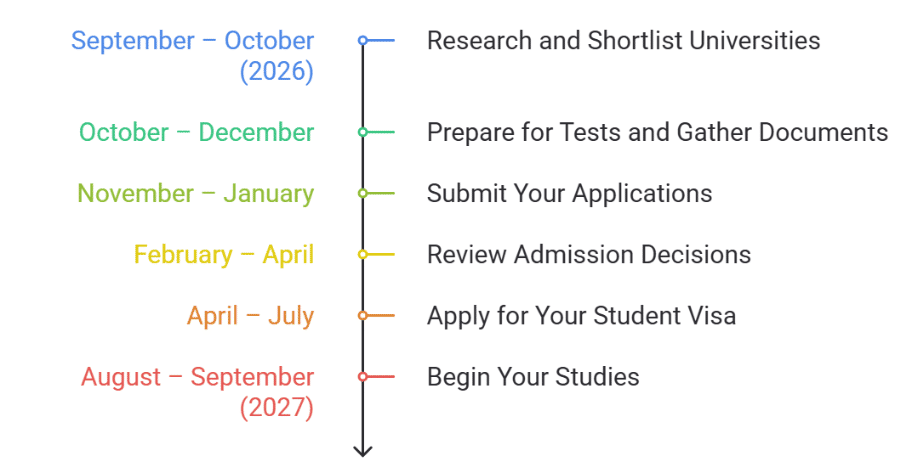
The table below shows a month-by-month plan for a Fall 2027 start.
Timeline
What Students Should Do
June–August 2026
Research and shortlist universities
July–October 2026
Take tests, and prepare your SOP, LORs and resume
October 2026–January 2027
Submit applications (bachelor's by 1 November or early January; master's mostly December–February)
December 2026–April 2027
Review offers; bachelor's students commit by 1 May 2027
April–July 2027
Get your I-20, pay the SEVIS fee, fill the DS-160 and attend your visa interview
August–September 2027
Fly out and begin classes
Your F-1 visa can be issued up to 365 days before your start date. You can enter US only 30 days before the start date on your I-20.
The next section explains exactly when to begin.
When Should You Start Preparing for Fall Intake?
Start 12 to 15 months before your intake. For Fall 2027, that means June to August 2026. Some scholarships close more than a year before the fall intake in USA months even begin.
Plan your months like this:
12–15 months before: Shortlist fall intake USA universities and check scholarship dates.
9–12 months before: Take IELTS, TOEFL, SAT, GRE or GMAT, if needed.
7–10 months before: Submit your applications.
4–5 months before: Accept an offer and get your I-20.
1–3 months before: Finish your visa, and book flights and housing.
Once you know when is fall intake in USA for your course, work backwards from that date.
Eligibility for the fall intake in USA depends on your level of study. Every university sets its own rules, and top schools ask for more. Always check your program page first.
The three checks below cover the basics.
Eligibility for Undergraduate Programs
Bachelor's applicants need to finish Class 12. Marks and test rules differ a lot between fall intake USA universities.
Most universities ask for:
Class 12 or an equivalent qualification
Strong marks in your last few years of school
IELTS (often 6.5 or above) or TOEFL (often 80 or above)
SAT or ACT scores, only if asked, since many universities are test-optional
Eligibility for Graduate Programs
Master's applicants need a bachelor's degree with good grades. A GPA of around 3.0 (about 75%) is a common starting point. Top universities usually expect more.
Most programs ask for:
A 3-year or 4-year bachelor's degree; check if your 3-year degree is accepted
A GPA of around 3.0 or higher
IELTS (often 7.0 or above) or TOEFL (often 90 to 100)
GRE or GMAT scores, where the program asks for them
Extra rules for some courses, like work experience for MBA programs
Financial and Visa Requirements
You'll need proof that you can pay for your first year. The university checks this before it sends your I-20. The visa officer checks it again at your interview.
Keep these ready:
Financial proof: Bank statements or a loan letter covering one year of costs.
Form I-20: Issued by your university after you accept the offer.
Passport: Valid for at least six months beyond your stay.
F-1 visa: Interview in your home country, with your social media set to public.
Most fall intake USA universities ask for the same core documents. Getting them ready early saves a lot of stress. Some, like Northeastern University, accept unofficial transcripts at first and ask for official ones only after admission.
Use this table as your checklist for the fall intake in USA.
Usually two or three letters from teachers or managers
CV/Resume
Lists your projects, internships and work
English Language Test Score
IELTS, TOEFL, Duolingo or PTE results
GRE/GMAT/SAT/ACT Score
Needed only if your program asks
Passport
Proves your identity and nationality
Financial Documents
Needed to get your I-20
Other Supporting Documents
Work experience letters for MBA, or a portfolio for design courses
Note: Keep clear PDF copies of everything in one folder.
Top Universities Offering Fall Intake in USA
Almost every university opens admissions for fall. It's the main intake, so nearly all programs take students in this cycle. This list of universities in USA for fall intake covers some of the most popular choices for Indian students.
The table below shows top fall intake USA universities and the programs students often pick.
The fall intake in USA deadlines differ at each of these. MIT, Stanford and Harvard close their early bachelor's rounds on 1 November 2026, and Carnegie Mellon's early round closes on 3 November. UT Dallas and Northeastern University keep master's applications open much later.
The next section shows you how to check your course.
How to Check if Your Course Is Available in Fall
Nearly every program runs a fall intake. Deadlines and seat limits still change from program to program. A quick check saves you from missing a date.
Follow these three checks:
Program page: Confirm your course takes students for Fall 2027.
Deadline: Note the fall intake USA application deadline for your exact program.
Admissions office: Email them if anything isn't clear.
This list of universities in USA for fall intake is just a starting point. Use it to build your own shortlist of 5 to 8 schools.
Top Scholarships Available for Fall Intake in USA
Fall is the best intake for scholarships, since universities give out most of their funding in this cycle. Scholarship dates often come before your fall intake in USA deadlines, so check them separately. Some close more than a year ahead.
The table below lists five well-known scholarships for fall entry.
Scholarship
Who Can Apply
Coverage/Benefits
Fulbright-Nehru Master's Fellowships
Indian citizens with 3+ years' work experience, in select fields like Economics and Public Health
Tuition, living costs, return airfare and health cover
Knight-Hennessy Scholars
Stanford graduate admits with a bachelor's earned in January 2020 or later
Tuition, a living stipend and travel for up to 3 years
AAUW International Fellowships
Women who aren't US citizens, joining their first master's or doctorate
$20,000 (₹18.90 lakh) for master's; $25,000 (₹23.63 lakh) for doctorate
Yale University Financial Aid
International undergraduates
Need-blind admission; meets 100% of need; average award of $72,941 (₹68.93 lakh) in 2024-25
Clark Global Scholars Program
International first-year undergraduates at Clark University
At least $15,000 (₹14.18 lakh) a year
Knight-Hennessy is one of the few awards that also covers living costs, and it closes on 6 October 2026. Learn more about theKnight-Hennessy Scholarship. AAUW and Fulbright-Nehru have already closed for 2027-28, so plan for their next cycle.
Applying for the fall intake in USA takes six simple steps. Most of it happens online. Start early so you don't rush any step.
Follow these steps in order.
Shortlist Universities and Courses
Start with a list of universities in USA for fall intake, then narrow it down to 5 to 8 schools. Nearly every program runs a fall intake, but deadlines and seat limits change from program to program.
Check these for each university:
Program page: Confirm your course takes students for Fall 2027.
Eligibility: Match your marks, test scores and experience to the program's rules.
Deadlines: Note the fall intake in USA deadlines for your exact course.
Funding: See if it offers scholarships for international students.
Admissions office: Email them if anything isn't clear.
Check the Application Route
Each of the fall intake USA universities has its own way to apply. Knowing the route early helps you pick the right round.
Look out for these:
Bachelor's: Most applicants use the Common App, which opens in August 2026.
Master's: You apply on each university's own portal.
Early Decision: It's binding, so you must join if you're accepted.
Early Action: It's non-binding. Stanford and Harvard run restrictive versions, which limit other early applications.
Program deadline: Note the fall intake USA application deadline for your exact course.
Prepare Your Documents
Your tests and documents tell the university who you are. Book your tests early so you have time for a retake, and start gathering documents at least three months before your deadline.
Plan for these tests, where needed:
English tests: IELTS, TOEFL, Duolingo or PTE
Bachelor's: SAT or ACT, if the university asks
Master's: GRE or GMAT, if the program asks
Keep these documents ready:
Academic transcripts
Test scores
Statement of Purpose (SOP)
Letters of Recommendation (LORs)
Resume or CV
Passport
Submit the Application
Once your documents are ready, it's time to apply. Most bachelor's applicants apply through the Common App, and master's applicants apply on each university's own portal.
Before you submit:
Fill in every section of the form.
Upload all your documents.
Pay the application fee.
Submit before the fall intake USA application deadline.
Track the Application
Your job isn't over once you hit submit. Fall intake USA universities may ask for missing papers. Most bachelor's decisions arrive by late March 2027, while master's offers come at different times, depending on the program.
Keep checking:
Your applicant portal every week
Pending documents or test scores
Emails about interviews or decisions
Apply for the Student Visa
Your visa journey starts once you accept an offer. Bachelor's students must decide by 1 May 2027, so compare costs, scholarships and program details before you say yes.
Follow these steps after you get an offer:
Accept and pay: Accept your top choice and pay the deposit before the deadline.
Get your I-20: Share your financial documents with the university.
SEVIS fee: Pay $350 (₹33,075).
DS-160: Fill in the online visa form.
Visa fee: Pay $185 (₹17,483) and book your interview.
Integrity fee: A $250 (₹23,625) Visa Integrity Fee may be charged when your visa is issued, so check the current status.
Your interview must be in India, and your social media should be set to public. A new rule also started on 15 September 2026: graduate students can't change programs or transfer schools without SEVP approval, so pick your course carefully. Learn more in our guide onSEVIS Fee for F1 Visa.
The fall intake in USA months start in August, so plan your departure early, since summer flights fill up fast. Before you fly, make sure you've done these:
Housing: Book on-campus or nearby housing.
Health insurance: Check your university's insurance rules.
Travel: Land within 30 days of your start date, not earlier.
Documents: Carry your passport, I-20, visa and offer letter.
The fall intake in USA is the main intake, while spring is the second option. The fall intake in USA months run from August to December, and spring runs from January to May.
The table below compares both intakes side by side.
Factor
Fall Intake
Spring Intake
Start Month
August or September
January
Application Period
November to January for bachelor's; December to June for master's, varies by program
Usually August to December
Course Availability
Widest range of programs
Fewer programs may be open
University Participation
Almost all universities take students
Fewer universities and programs
Scholarships
Most funding options
Often more limited
Preparation Time
Needs earlier planning
Good if you need extra months
Internship Opportunities
Better matched to the main hiring cycle
May vary by program
Knowing when is fall intake in USA and when spring starts helps you pick the right one. Read our guide onMaster's Intake in USA to compare all three intakes.
Conclusion
The fall intake in USA gives you the most choices, the most programs and the best shot at scholarships. That's why most Indian students aim for it.
The key is planning early. Start 12 to 15 months ahead, shortlist fall intake USA universities and track every fall intake in USA deadline in one place.
Once you know when is fall intake in USA for your course, work backwards from there. Build your list of universities in USA for fall intake, apply on time and start your visa as soon as your I-20 arrives.
Classes start in August or September. The fall intake in USA months run from August to December. Most fall intake in USA deadlines fall between November and January for bachelor's programs.
When does spring and fall intake in USA take place?
Fall starts in August or September, and spring starts in January. The fall intake in USA is the bigger one, with almost all fall intake USA universities taking students. Spring usually has fewer programs.
When is fall and spring intake in USA?
The fall intake in USA months are August to December, and spring runs from January to May. Each fall intake USA application deadline comes about 7 to 10 months before classes, while spring deadlines fall between August and December.
When to apply in USA for fall intake?
Apply between October 2026 and January 2027 for most programs. If you're wondering when is fall intake in USA and how early to apply, bachelor's early rounds close on 1 November 2026. Check each fall intake USA application deadline, since master's dates can run till June, and build your list of universities in USA for fall intake early.
Can Indian students apply for Fall Intake in USA?
Yes. Indian students can apply for the fall intake in USA if they meet the academic, English and financial rules. You'll also need an F-1 visa, with your interview done in India.
How much bank balance is required for Fall Intake in USA?
You need enough funds for one full year of tuition and living costs. The exact amount is listed on your university I-20 request form. Bank statements or a loan letter can be used as proof.
Is Fall Intake better than Spring Intake in USA?
For most students, yes. The fall intake in USA offers more programs and more scholarships. Almost all fall intake USA universities take students in this cycle, while spring has fewer choices.
Can I get scholarships during Fall Intake in USA?
Yes, and fall is usually the best intake for funding. Many awards open during the fall intake in USA, like Knight-Hennessy and Yale's need-based aid. Check the list of universities in USA for fall intake you like for their own scholarship deadlines.
Do all US universities offer Fall Intake admissions?
Almost all do, since fall is the main intake. Most fall intake USA universities open nearly every program in this cycle. Always check your program page, even if the school is on your list of universities in USA for fall intake.
What happens if I miss the Fall Intake application deadline?
You can apply for spring or wait for next fall. Some programs have later dates, so check every fall intake USA application deadline before you give up. At UT Dallas, for example, master's applications stay open till 1 August, even after most fall intake in USA deadlines have passed.
Is it easier to get internships during Fall Intake in USA?
Usually, yes. The fall intake in USA months line up with the main hiring cycle. You finish your first year by summer, which is when most internships start.
upGrad Abroad Editorial Team |5025 articles published
We are a dedicated team of study-abroad experts, ensuring intensive research and comprehensive information in each of our blogs. With every piece written, we aim at simplifying the overseas education ...
Refer Your Friend & Earn upto ₹15000
Help your friend upgrade to a Global Career and earn rewards together.